In 1998, the German region of the United Evangelical Mission (UEM) asked me to start a ministry with migrant Christians. At the time, there were few concrete ideas: it was only clear that Christian migrants might be in need of fellowship and a place to worship. (The aim of the project was not to evangelize—the evangelical churches in Germany see their role toward migrants more in diaconal and advocacy terms. Evangelical Free churches, on the other hand, have long seen Muslim and atheist migrants coming to Germany as an evangelistic opportunity; these Christians hope to convert people who would move back to their home countries as Christian leaders and missionaries.) The plan of UEM was to start one or more international congregations, gathering migrants from different cultural and possibly denominational backgrounds.
 |
Instead of coming across individual migrant Christians in need of pastoral care and a Christian community, I was met with organized churches. Within two years, more than six hundred such churches were identified in the state of North Rhine-Westphalia alone. They are Eastern and Oriental Orthodox, Catholic, Protestant, and Pentecostal. A surprisingly large number of such congregations describe themselves as non-denominational; however, they are clearly charismatic in character.
Orthodox Christians tend to come from Eastern Europe, the Near East, and Ethiopia. Catholics come from all over the world, although Eastern and Southern Europeans dominate those churches. Protestants are usually European or East Asian, while Pentecostals and non-denominational charismatic groups are overwhelmingly African (although there are also sizeable numbers of Asian and Latin American churches). In major cities like Dusseldorf or Cologne, likely as many migrant Christians attend a “migrant church” on any given Sunday as Germans attend a German church.
It soon became clear that a ministry with migrants should not consist of starting new churches; rather, it should concentrate on supporting existing congregations and efforts toward closer cooperation between indigenous and migrant churches.
Reverse Mission Movement
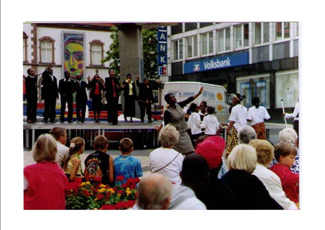
As the years went on, I learned that new Pentecostal and charismatic migrant churches were constantly forming. Some of them split from existing churches, but others were consciously planted as missionary endeavors. Talking to founders and pastors of such churches, I learned that while outwardly they have come to Germany as refugees or economic migrants, they really see themselves as missionaries brought here by the Holy Spirit. 
Some talk of a “missionary call” they received even before coming. Most did not realize their calling until after they arrived. Seeing a country where large Christian churches dot the landscape, but where worship services on Sunday are attended by only a handful of elderly people, they came to understand themselves as charged with bringing revival to a dying church and to “bring Germany back to Christ.”
|
|
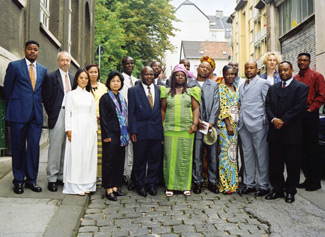
These churches do not constitute a “diaspora,” a group of displaced people who stick together in a foreign land to protect their cultural and religious identity; rather, they make up a “reverse mission” movement.
To reach out to Germans, most missionary migrant churches engage in street evangelism. In addition, a number have switched to bi-lingual or even completely German-language Sunday worship. Pastors are learning how to preach in German, or use interpreters to get their message across. Some gospel choirs even sing in German.
To date, these evangelistic efforts do not seem very successful. Even large, very international churches have relatively few German members. In some migrant churches, Germans who were evangelized and baptized there eventually left and joined a German-majority church, saying that, in the end, they never felt at home in a migrant majority environment. But the migrant mission to Germany is still young, and more fruit may be seen in the coming years.
The Reaction to Reverse Mission
So how have German churches reacted to this reverse mission? For a long time, they did not realize what was happening. Because most missionary migrant churches have been operating outside of German church networks, they were hardly ever noticed. This, despite the fact that many rented worship spaces from German Protestant churches. German Protestants tended to view all churches started by migrants as diaspora churches exclusively serving the spiritual needs of migrants. As awareness of the huge number of “missionary” migrant churches started to spread, however, German churches and Christian groups began to realize the need to engage with them.
In general, evangelicals have been more welcoming to migrant missionaries than mainline Protestants. The Coalition for Evangelism, a network closely related to the German Lausanne Committee, has been making a conscious effort to inform its members about the presence of migrant missionaries and has been inviting migrant church leaders into its leadership. However, this has not been as effective as many hoped it would be, since migrant churches are typically more interested in practical projects than in building structures and organizations.
Evangelical/charismatic evangelistic projects like “Halleluja Ruhrgebiet,” a large, open-air rally during the 2006 World Soccer Championship, have been more successful in integrating missionary migrant churches.
Evangelical Free churches have also been increasingly welcoming. Baptist churches are working hard to integrate migrant groups into their existing congregations, often offering a second worship service in a language other than German.
However, since most missionary migrant churches are Pentecostal or charismatic in character, it is not surprising that the Federation of Free Pentecostal Churches in Germany (Bund freikirchlicher Pfingstgemeinden, BfP) has been most open toward these new church plants. Within the last ten years, the BfP has accepted more than 120 migrant congregations into its fold, so that they now make up about twenty percent of its base.
Nevertheless, the Protestant churches have begun to assist missionary migrant churches in certain ways. In Hamburg, Wuppertal, Frankfurt, and Neuendettelsau, churches and mission agencies have devised courses to train leaders of migrant churches for their missionary role in Germany. Course content includes: intercultural hermeneutics and intercultural communication; German theology; history and sociology; and practical exercises like preaching in a German congregation.
Facing Obstacles
The Protestant churches’ ministry with missionary migrant churches has faced many obstacles. Some are social and political in nature: migrant churches are often structurally and financially weak and hope for support to establish their own structures. German churches, facing financial cutbacks and shrinking resources, have been reluctant to provide such help; at the same time, they have expected migrant churches to get involved in international worship services and other “multi-cultural” events. Not surprisingly, migrant Christians sometimes feel exploited. The fact that they are usually asked to provide music and food, but rarely the sermon, strengthens this suspicion.
When it comes to cooperation in concrete projects, the differences in the lives of marginalized migrants and (usually) middle-class, indigenous Christians can cause difficulties. A German church which invites a Nigerian speaker for a Saturday afternoon seminar has little understanding when the speaker must cancel at short notice because his boss has ordered him to work overtime.
Other obstacles are theological:
- differing concepts of mission and evangelism
- many missionary migrant churches follow a strong “spiritual warfare” theology which rather repels German Protestants and evangelicals
- differing interpretations of migration
- few Germans are able to see migrants as more than economic or political refugees who are here on sufferance
- differing definitions of what makes someone a pastor; most missionary migrant church leaders have had little or no theological training and insist that a spiritual call and charismatic giftedness are all that is needed for their ministry
Next Steps
Dialogue is overdue on all of these issues. Only the UEM has begun a theological dialogue on reverse mission between German Protestant and missionary migrant churches; it will run a series of consultations on spiritual warfare beginning later this year.
This dialogue is needed to prevent missionary migrant churches from becoming ghettoized and even more isolated from the general German church context. There needs to be a willingness to really make contact and accept each other, despite deep theological and social differences. The German churches must learn that Germany is no longer a Christian nation and needs missionaries from abroad—even if they weren’t invited. Migrant churches need to learn that to effectively evangelize, they have to contextualize their message and their church life.
There is also a political dimension to this problem: Who is allowed to define Christianity in Germany? So far, it has been the German Protestants. It is the German churches who are featured in the media, who have money and political and social influence. In the national discourse on migrants and religion, the question of Islam dominates to such an extent that most Germans do not even realize that there are almost as many Christian migrants in the country as Muslims.
There is also an ecclesiological question that needs to be asked: Are churches defined by denomination and/or by nationality? In the German Evangelical Church, both national identity and denominational identity are strictly upheld. In such a context, migrants remain the other. If your skin is black, it does not matter if you were born and raised in this country and hold German nationality—you remain a foreigner. Similarly, migrant majority churches are, by definition, “foreign” churches to which we have an ecumenical relationship; they cannot really be part of “us.” For true integration of migrant churches, the German churches will have to relearn what it means to be part of the multinational Body of Christ.
