
“Ma’am, there is a 2-month-old infant born in a pushcart to a scavenger family,” Lisa, a gaunt-looking young woman, reported to me after dinner one night in January. She, her husband Freddy, and daughter Claire have lived in the streets of Metro Manila for eleven years. A few nights earlier, after listening to tale after tale of police harassment and constant illness, I invited Lisa and Freddy to live temporarily at my home.
|
|
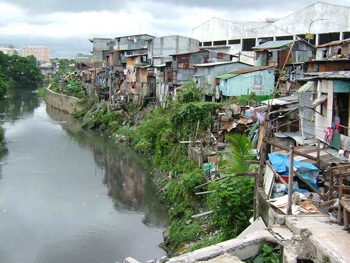
“Where is this family with the infant living?” I asked Lisa. She explained, “Under a street shed a block away if it rains, and under the trees three blocks away during the day. At night, they sleep in the pavement in front of a bank.”
“Let’s go find them,” I insisted. As we approached the shed, a block away from my home, I noticed the tiny baby nestled in a cotton blanket lying silently at the edge of a pushcart, piled high with empty plastic bottles, scrap-tin cans, and old lumber. I saw the mother seated next to her three little children and tending a fire built from a square gallon can and fed by sticks of wood from a broken chair. The father was banging on tin cans, flattening them out, and preparing them for sale to a junk shop. Their 3-year-old boy was tied by the ankle to the pushcart to keep him from running out into traffic.
The baby was so frail and fragile I could literally hold her in the palm of my hand. This family now had my full attention, and I was drawn in to learn more. I found myself becoming personally involved in the lives of these two families, one of which lived adjacent to my own home. I felt the tug of something more than curiosity pressing me to find out more about a couple who, with their eight children, has lived on the streets for over twenty years.
Anna’s Story
The story starts with Anna, the 34-year-old mother, when she was eleven years old and living in Bacolod, an island city far south of Manila. She relates her experience as follows:
One day my mother explained to me that we were very poor. There was a man she knew who was going by ship to Manila. He would take me to the city to a family who would take care of me, provide schooling and a job for me—basically give me a new life. I was excited, took my few belongings, and boarded the ship, expecting a great adventure. For the first time I would have a chance to study and work at the same time.
When we arrived in Manila the man walked off the ship and told me to stay on the dock until he returned. I saw the man take my plastic bag with all of my possessions and walk away. Never suspecting evil, and with a heart full of hope, I watched people come and go until it started to get dark and a guard ordered me to leave the dock. My high expectations turned to lonely fear as hunger took over and the night closed in. I never saw the man again.
With nothing in my hand and no destination in mind, begging became my only means of survival. Hours of terror turned into days of panic, then apathy. I did not know anyone in the city. I did not know where to go. I was totally abandoned. I was afraid. At night, the pavement was my bed.
Amazed by Anna’s resiliency, I asked her how she managed to survive. She replied,
I begged. There was an old lady who took pity on me and fed me for a few months. Later on I met Tony, an orphaned 15-year-old boy who had ran away from home because of an altercation with his brother. He saw my plight, befriended me, and showed me how to live on the streets. Together, we faced an unknown future.
I didn’t learn everything about Anna and Tony’s life on that first day, or the second. I picked up little pieces here and there as I visited with them on the streets during my daily walks. As details of their story emerged, I learned that for twenty years “home” was a six foot by four foot pushcart occupying different street locations in Metro Manila. The pushcart doubled as the store where they did business and the sleeping quarters. 
A New Revelation
As I understood more of their story, many thoughts ran through my mind. My ministry is with the poor, but I have never become that involved directly with a destitute street family. My husband and I helped establish more than five hundred preschools in the Manila slums, created jobs through an organic farm, and set up an employment agency hiring hundreds of people. But how were we to really help this one needy family who has survived on the street for two decades? And why had no church, mission agency, or social service agency ever helped them? I continued to grapple for an answer as I walked the streets.
All of a sudden, while walking home one day, Isaiah 58:6-7 kept ringing in my ears. Verses I had memorized years ago flashed back:
Is not this the kind of fasting I have chosen: to loose the chains of injustice and untie the cords of the yoke, to set the oppressed free and break every yoke? Is it not to share your food with the hungry and to provide the poor wanderer with shelter—when you see the naked, to clothe him, and not to turn away from your own flesh and blood?
I remember studying this passage that revealed God indicting his people for their false religiosity. They prayed, read scriptures, sang hymns, and attended sacred rituals; however, they neglected to do justice, to help the needy. They equated worship with religious activities instead of the doing of justice. At that moment, I knew I had to act justly in relation to this family.
I rang up some mission agencies. None had any facilities for street families, only children. Deep inside, I knew I had to assist this family. But how? I counseled myself, “You have to set some boundaries.” My schedule was already extremely full: teaching in a seminary, networking globally, administrating a city network, and overseeing an employment agency, an organic farm, and a grassroots ministry.
One evening, when the rain was coming down especially heavy, I thought again of Michelle, the tiny 2-month-old infant. The children were caught in the rain, getting wet and possibly ill. Could they not be sheltered in our living room? I stepped out into the rain, looking for them at their usual location, and found them. They accepted my invitation to shelter with us for the night.
For my husband and I, this was the beginning of a life-changing relationship, not only with Lisa and Freddy who were already with us, but with Anna and Tony. For three weeks, these two families shared our home and table as we considered more permanent living situations for them. Our living room became their bedroom. Our garage became a safe place to park their pushcarts filled with recyclable items. Around our dining table we shared common meals day by day.
The Challenge of Finding a Job
During this 3-week period, Stewart and I tried employing Tony and Freddy on our mission farm. But friction arose when Tony and Freddy’s children clashed with the farmers’ children. It soon became obvious that the farm families were not prepared to live together with the street families.
Since both families have experience in construction and painting, we found them work fixing up a rental home nearby our home. Once again there were personality clashes between the two families.
|
|
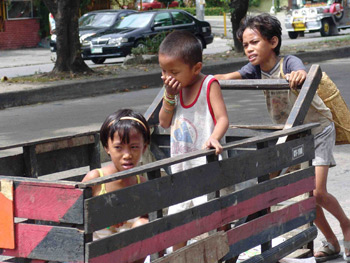
Freddy and Lisa decided to return to their recycling business. We assisted them in the purchase of a pedi-bike with a sidecar, making it easier for them to haul and sell their junk. The additional income gave them the capital to find a small room in which to live. After completing the house renovation project, Tony went back to working on our farm, taking care of a newly-constructed fishpond.
The Challenge of Total Healing
Tony, with his large family, faces many predicaments not of his own choosing. Among them are serious and long-standing issues—emotional, psychological, and physical—that require healing. His children have been malnourished for years and carry the signs of chronic hygienic neglect. As their story unfolds still further, their lives take on tragic proportions. He recounts with great sadness the loss of several children under unimaginable living conditions:
Our 6-year old son, Kalbo, was placed in the care and keeping of our older 11-year-old boy. Walking through the marketplace, they were separated and we have never seen Kalbo again. We have been searching for him in government shelters, but he is nowhere to be found. Our 2-year-old daughter took on a fever and was admitted to the hospital. When it was time for her release, we lacked the funds. My wife and I went out to find the money, but when we returned a few days later, our daughter was gone. We never saw our daughter again.
One day, we were desperate. We had no food and our little children were starving. A couple approached us and offered us 1,000 pesos (20 USD) in exchange for our other daughter. We turned her over to this couple, hoping that she would have a better future with them. So now we only have five kids. I feel very sad for losing my three children.
The Challenge of Locating Housing
We prayed and searched for affordable housing for Tony’s family. One day we met a civil engineer who was building transitional housing for the poor. Unfortunately, the units had already been allocated. So Melchor, our farm manager, offered to rent out his family’s unused house. This worked out well for the family. They are now comfortably settled in a 2-room house across from a small local church in Binangonan, a suburb of Metro Manila.
The Challenge of Educating the Family
Romel, the 16-year-old, is illiterate and has expressed a desire to learn. After some research, I found an agency willing to help him. After one week in the 10-month program, he complained of feeling bored to death, “like a prison.” Unable to remain, Romel took off for the streets. When we caught up with him again, he asked that we place him in a “regular” (public) school like his younger siblings. We were able to place him in a special education program but, again, after only a few days in school, he returned to the streets.
The smaller children are a different story. Each has been successfully enrolled in school, but only after solving the problem of birth certificates. You see, children born in pushcarts don’t possess formal birth certificates. Only after a local pastor agreed to baptize each of the children, and issue a baptismal certificate, were they accepted into school.
Onel, age 11, should be in the fifth grade; however, due to malnourishment and lack of any formal education, he has been enrolled in first grade. He is exuberant to carry books and notebooks and to sport a brand-new uniform. Kikay is four years old and enrolled in preschool. You should see her strutting around in her uniform and announcing how she is going to school. Contrast this with so many children from middle-class families who only groan and complain when school doors open. For Tony’s children, it is a privilege they could not have imagined.
Of course, Tony and Anna can’t read or write either. Kikay’s teacher has agreed to tutor Anna, and another farmer is mentoring Tony in various parenting and home management skills.
The Challenge of Discipling the Family
How do you disciple a family who has led an itinerant life on the streets for twenty years? They need to learn how to set up a safe and secure home, to provide guidance to children who have been accustomed to running unsupervised in the streets, to manage a week’s worth of money (instead of spending it all in one day), to live in a settled residence, and to integrate their lives into a local group of believers.
While the two families were staying at my home, I would tell them stories about Jesus and his love for them. One day, Tony and Anna prayed to receive Jesus into their lives. We arranged for Romel to attend an evangelistic youth camp and he became a believer. However, being illiterate, they could not read the scriptures for themselves. And they were too embarrassed to visit a local church without me accompanying them. So I introduced them to another farmer, Melchor, who is teaching Tony how to read and to follow the way of Jesus.
Reflections
My encounter with Anna and her family has served to slow down my frenetic lifestyle. Now, whenever I visit them, the children rush up to me to be picked up and hugged. I was not gifted with my own biological children; however, I am now enjoying the soft presence of a tiny infant, the warm hugs of a 4-year old girl, and the loving kisses of a 3-year-old boy. The kids are teaching me to play and laugh again. They provide a blessed reprieve from my academic and social action responsibilities.
As I have entered the world of this family who, for twenty years, struggled to survive on the pavement of Metro Manila, I wonder how God must be feeling toward the collective failure of the Church, the state, and the business sector to care for Tony, his family, and the hundreds of thousands like them who continue to eek out a miserable daily existence.
An important theme in scripture is the value God places on families. The Word in Life Study Bible explains that, “The family is the primary institution established by God (Genesis 2:23). Before there were any nations, cities, or other human communities, there was a family. Logically and chronologically, family comes first.” God’s intention is that each child be nurtured within the love and care of a family. However, in the case of Anna, the acceptance, provision, self-confidence, and health that God intended the family to provide came to an abrupt end when she was abandoned at the age of eleven. Now, when God looks at Anna and Tony’s family, he sees disintegration, deprivation, disempowerment, and disease.
Ironically, a few blocks away from this street family’s former hideaway is a major evangelical seminary, four huge churches, several upscale restaurants, hundreds of business establishments, and hundreds of largely upper-middle class families. A challenge I face is how to mobilize their support on behalf of the five hundred street families and individuals whose lives are rooted in our neighborhood.
A few weeks ago I asked Anna what had changed in her life since we had become friends. After a moment’s reflection, she replied,
My family and I are closer to Jesus and to each other. We love attending the church across from our new home. The pastor and his wife care for us. She is teaching me and my children how to read and write. I am so happy here. We have a roof over our head. At last my children are going to school. This has been my long-time prayer. Melchor and Enalyn (our farm managers with thirteen children) are kind and helpful to us. They take time to listen to our stories, and bring us to the market and hospital. We feel we belong to a big family. They are like our parents to us and you and Sir Stewart are our grandparents. Above all, we are scavengers no more!
Please continue to pray for Tony and his family. Pray for God’s provision for a more permanent housing for them and a more stable source of income. Pray for our plan in Mission Ministries Philippines to establish an integrated, organic, and sustainable farm institute enabling homeless families like Tony’s to learn skills in urban agriculture and alternative farm systems like hydroponics. Pray for wisdom for me and our staff as we seek God’s direction in setting up an ecologically-sound and sustainable Christian community where the rich and the poor can dwell together in unity manifesting the presence of the Kingdom of God.
